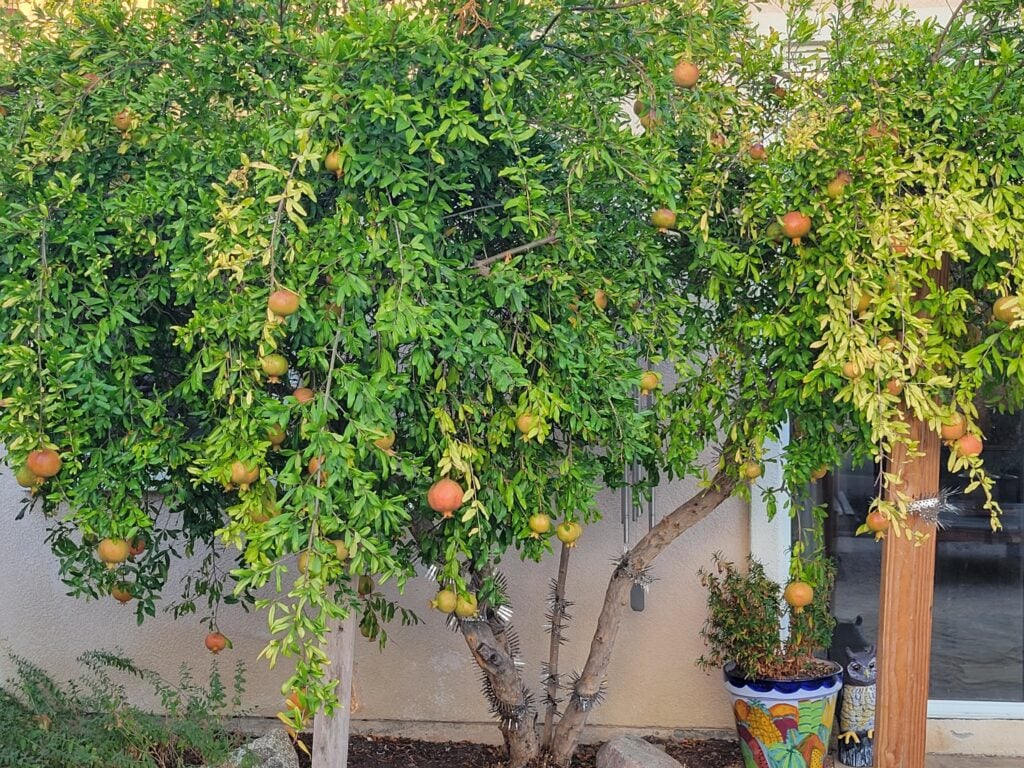
There is a pomegranate tree outside my kitchen window. Her name is Pommy.
She is twenty-five years old, and every year, without fail, without coaxing, without asking anything from me in return, she flowers red in the spring for the bees and the hummingbirds, and in the fall, she gives so much fruit that her branches bend toward the ground under the weight of it. Every year I bring two-by-fours from the garage to prop them up. Every year her generosity amazes me.
And every year, the critters come.
Squirrels. Rats. Opossums. Birds. Whatever else moves through in the dark while I am sleeping. I have always expected this, and I have always accepted it — mostly. They need food. In summer here it goes past a hundred degrees, sometimes reaching a hundred and fifteen, and what they’re taking sometimes isn’t even food. It’s water. It’s survival. I know this. I don’t begrudge them some of what Pommy gives.
But some years they take more than some. This is one of those years. The squirrels came back brazen, digging burrows along my house, dragging whole pomegranates underground. I was pondering my limit, until one evening at dusk I looked out and saw the rat.
That was when the battle truly began.
— — —
I want to tell you what I have tried over the years, as testimony. Although, this year, I confess, my efforts began to feel more like comedy.
Cayenne pepper spray, homemade, applied directly to the fruit. Chicken wire around the base of the trunks, wrapped around the two-by-fours I use to prop up the branches. Tinfoil around each trunk, all the way up to where the branches divide. My son’s dog, let out to chase them — until it got too hot for that. This season, a solar-powered plastic owl with glowing eyes and a rotating head, bought on my daughter-in-law’s recommendation. And when I saw the rat for the first time, I went out with the broom handle we keep in the sliding door track for safety, and I tapped the branches until it leapt — six feet, through the air, into the sage bushes alongside the fence. I stood there amazed at the creature’s capability.
Refusing defeat, I went and bought metal spiky strips, the kind used on buildings to deter birds. I bent them around the trunks with wire and zip ties, working carefully so the lizard who likes to sit at the base of the tree could still have its spot. I wore work gloves and still drew blood.
The next morning there were pomegranate peels on the ground again … and droppings. The rat had found the one two-by-four I hadn’t wrapped.

I wrapped it. I moved the owl into the tree, as my son rightly pointed out that an owl on the ground probably did not frighten them. I took my husband’s advice and removed the chicken wire — don’t make it easy, he said. When I saw the owl’s glowing eyes and spinning head in my tree that night, I had to laugh.
The morning after that, more peels. More droppings.
I sighed, I lowered my head and sat in a chair with my coffee next to Pommy. And that is when I looked up at the roof line.
— — —
On the south side of my house, my neighbor’s pepper tree — planted deliberately close to the fence, as he told me himself — is now taller than my two-story house. Beside it, sumac trees also drop tiny leaves and seeds across my yard in the afternoon wind, every day, all summer long. That same morning, before the coffee, I had cleaned up an entire trash can full of leaves that were not mine to deal with. I had trimmed back the overgrown sage to make it harder for the rat to leap. I was already tired in a way that had nothing to do with the rat.
While looking up at those branches close to my roof line, I understood. The rat wasn’t climbing the spikes. It was crossing the roof. It had found a pathway I hadn’t thought to close, and it would always find one. Because that is what appetite does — it finds the way through every gap you leave and several you didn’t know existed. In that moment, it would have been easy to blame my neighbor.
And standing there, tired, bleeding through the work gloves, cleaning up someone else’s mess while my own fruit was taken in the dark — something cracked open.
When did I start spending my life this way?
— — —
There is a teaching I have carried for a long time. It goes like this: when a wheel generates power from the water flowing through it and then begins — of its own volition — to withhold that water, it does not gain more power. It stagnates. It is only when the water flows freely through that the wheel generates anything at all.
To receive more, we must give out what we have received.
I know this. I have known this for years, in the way we know things in our minds before we know them in our bodies.
Yet, standing in my yard that morning, I felt it differently because I realized I had not been protecting abundance. I had been protecting against the fear that abundance wasn’t real. That if I didn’t guard it, there would be nothing left for me.
Here is the thing about Pommy that undoes that fear every time I let myself see it: Pommy has never failed. Twenty-five years. Not one year without the red flowers, without the heavy branches, without more pomegranates than I can eat, give away, peel and freeze and share. Not once.
The tree is not afraid. The tree doesn’t calculate what was taken last year before deciding how much to give this year. Pommy just flowers. Pommy just fruits. The generosity is not contingent on what gets protected.

The squirrels and the rat do not struggle with manifestation. They move toward what they need with complete confidence that it will be there. And it is. The ecosystem I built — the native plants, the shade, the water, Pommy at the center of it all — it holds them as it holds me. They never lie awake wondering if there will be enough.
The wondering lives in us.
And I find myself wondering — when did we stop believing abundance was real? When did the protection become more familiar than the plenty?
This is not a teaching about passivity. Boundaries are real. The desire to receive what you have tended is real. There is a difference between open hands and no hands at all.
But I had stopped asking for what I actually wanted and had spent the whole season organizing myself around what I wanted to prevent. There is no abundance available in that posture. There is only the battle, and the fatigue, and the morning with the coffee and the lowered head.
What I want — I realized, sitting there — isn’t only pomegranates. I want to enjoy Pommy. I want to sit in her shade on a hot afternoon and feel what twenty-five years of tending something feels like. I want to receive what she gives in the spirit she gives it — which is without withholding, without fear, without counting.

And if I open my hands, it won’t necessarily be more pomegranates that comes in.
It will be what I’m actually asking for.
The question is whether I know what that is. Whether any of us do — at least not in the clean, unambiguous way the squirrel knows it wants the pomegranate and goes directly to it.
Perhaps I don’t know yet. Perhaps the knowing takes time, and some quiet, and hands that are no longer full of wire and zip ties. Still, I can begin there. I can ask the question honestly, and let that be enough for now.
And perhaps that is where the barricading actually stops. Not through surrender, and not through winning the battle — but through turning toward what we actually want. When I know what I’m asking for, I no longer need to grip what I have. The wheel can move. The water can flow. The energy that has been standing guard can become the energy of receiving.
We carry consciousness of relationship. The capacity to love a tree for twenty-five years, to notice the lizard, to feel the particular grief of watching something sacred be taken without reverence. That is not a burden. That is the gift.
But the gift asks something of us in return.
Open hands. Not empty hands. Hands that have released what they were gripping so tightly —
so there is room for something to arrive.
— — —
What are you protecting past the point of peace? And what might be waiting on the other side of open hands?
— — —